The police have postponed Everton's home fixture with Stoke so the BNP can have a get-together in Liverpool. With any luck, this means that Nick Griffin has got on the wrong side of the Blues' vaguely Christopher Walken-esque manager David Moyes.
I've met the Hungarian police a few times this week. On Tuesday, a couple of pensioners burgled a flat in our block (you've read that right - Jenny's description makes it seem like a particularly vigorous outing for Compo and co). The Rendőrség pulled up in their car about two hours later, just as I was attempting to get into the block without my outer-door key. The leader walked over to me and tried gamely to speak English while I tried gamely to speak Hungarian, a conversation which eventually elicited the information that I 'should' drink the bottle of wine I was holding in my hand. Still, at least he didn't confuse me with the superannuated robbers.
Then, on Wednesday, I made my usual short-cut to WestEnd mall, an implausibly large shopping outlet containing about three million shoe shops, through Nyugati Station. The station had been evacuated the day before because workers had found some unexploded WWII grenades on a construction site next door, so the Rendőrség had decided to go and do some tokenistic 'anti-terrorist' quota-filling in the station. As in Britain, this generally involves stopping all men between 14 and 40 and making them feel guilty for a couple of minutes. In this case, they checked my passport briefly and returned it politely, without the supercilious attitude that I've seen so often from British police (particularly at football matches, where I've witnessed some absolutely ludicrous timesheet-completing activities.)
Don't get me wrong, I'm very far from being one of those 'maaaan, the police are, like, always bad and that' type people,* and I've met some very polite and helpful PCs in Britain, Hungary, Italy, Portugal, and Spain (where an officer just chuckled and gave me the right answer when, rather tipsy, I asked him for directions to the train station I was standing right outside at five in the morning. In Italian.) But I'm convinced that I have one of those faces. My criminal record is pristine, but I have:
- been asked for my name and address whilst mucking about innocently in a park, aged 14.
- been thrown out of a W.H. Smith store by a security guard, aged 13, because I'd been in there 'too long'. (I was looking for Christmas presents, you wanker.)
- had my luggage and all my possessions heavily scrutinised by the French douanes at Calais on two separate occasions. I admit that the second time this might have been provoked by my making a sarcastic remark, but I only did that because the police were treating everyone like idiots, as they generally do in France.
- been put into an 'escort' on my way to a match at Lincoln, only to realise that it was full of the full complement of Hogan's finest, who'd travelled en masse to the end-of-season fixture in the hope of a 80s-revivalist pagger.
- Been accused at Carrow Road of beating up a Dagenham & Redbridge supporter outside the ground and stealing his ticket. In all fairness, this was due more to some lacksadaisical organisation (it's a long and boring story) on an ex-girlfriend's part than to over-zealous policing
, but still...
I used to sit opposite a hopeful for the police when I had a rubbish job at a stationery wholesalers. He was a nice guy, and intelligent, but he had this spooky regard for 'the law' as this immutable, inherently correct thing which made me wonder about what his attitude would be if he lived in a country which places less emphasis on personal freedoms than the UK - Berlusconi's Italy, for example. One of the many ways in which I used to kill time in that job was by constructing ethical dilemmas of ever-increasing baroqueness for him to solve, but his answer was always 'if it's against the law, it's against the law, and I'd arrest them.' I hope that not all potential PCs are so dogmatic. I should add, in mitigation, that he had an uncanny attractiveness to muggers and random assailants, and that he was from Grimsby, a town which could make anyone yearn for some Dixon of Dock Green-style idyll.
Anyway, I'm thinking of going to the football this afternoon, so we'll see how they do 'crowd'** control in Budapest.
* My uncle is a raconteur ex-policeman with a caché of good stories. He arrested Keith Moon at Prestwick Airport once. Moon pulled a 'gun' on him, and pulled the trigger, only for a flag with 'bang' written on it to protrude from the muzzle...
** Average attendances at Soproni Liga 1 games have dropped below 2,000 this season, largely due to the fact that Hungarian football has been ruined by corruption since 1989, and everyone in BP supports Italian, German, and English teams. 2,000 would be understandable in a country the size of, say, Slovenia, but Hungary's population is twice Scotland's. I'm thinking of going to see my local team, current champions MTK, play Kaposvar at 5.00pm, but I'm slightly depressed by the thought that they've had <1,000 gates this season.
Showing posts with label places. Show all posts
Showing posts with label places. Show all posts
Saturday, 21 February 2009

Monday, 16 February 2009
Beat that, Gordon Brown...
For Valentine's Day, we took the chairlift up to the top of Janoshegy and messed around in the snow:

Hungarians, like most Europeans I have ever come across, don't find the notion of spending all Saturday in the pub watching Sky Sports News very appealing. Free time and fresh air are treated as sacrosanct, so the summit of Janoshegy was, in spite (or because) of the weather, crawling with daytrippers sledging, cross-country skiing, ambling, and, er, jogging. Anyway, it was all very bracing.
Fresh air makes you hungry, so we jumped off the bus back to Pest before it crossed the river and went for a pizza in a side street off lovably grim transport hub Moskvá Ter. Afterwards, we thought it might be a good idea to wander over to the cinema and see if there was anything worth watching. Our options were The Dark Knight (vetoed on grounds of length and Jenny's intolerance for relentless grimness) and Revolutionary Road (vetoed on the grounds of my dislike of shit films.) So, giving up on the idea, we set off through the mall to take a tram back to Pest.
Then we saw, of all people, someone who I am 99% sure was controversial Hungarian PM Ferencz Gyurcsany - apologies for using the English name order, I still can't help it - stepping out with his wife and who I presume was his daughter. They were followed by two heavies, so whether it was FG or not (and my new students say that there was no reason that it shouldn't have been) it was certainly someone reasonably important and stately looking. What was odd was that I didn't observe anybody making a big deal of his being there.
I hope for his sake he went to see The Dark Knight rather than Revolutionary Road. RR sounds like it has a serious dose of authenticity-itis: 'if it's miserable, it must be good etc etc.' Every cinema in Budapest is showing it about sixteen times a day...
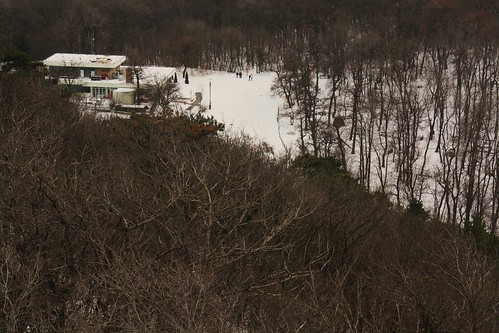
Hungarians, like most Europeans I have ever come across, don't find the notion of spending all Saturday in the pub watching Sky Sports News very appealing. Free time and fresh air are treated as sacrosanct, so the summit of Janoshegy was, in spite (or because) of the weather, crawling with daytrippers sledging, cross-country skiing, ambling, and, er, jogging. Anyway, it was all very bracing.
Fresh air makes you hungry, so we jumped off the bus back to Pest before it crossed the river and went for a pizza in a side street off lovably grim transport hub Moskvá Ter. Afterwards, we thought it might be a good idea to wander over to the cinema and see if there was anything worth watching. Our options were The Dark Knight (vetoed on grounds of length and Jenny's intolerance for relentless grimness) and Revolutionary Road (vetoed on the grounds of my dislike of shit films.) So, giving up on the idea, we set off through the mall to take a tram back to Pest.
Then we saw, of all people, someone who I am 99% sure was controversial Hungarian PM Ferencz Gyurcsany - apologies for using the English name order, I still can't help it - stepping out with his wife and who I presume was his daughter. They were followed by two heavies, so whether it was FG or not (and my new students say that there was no reason that it shouldn't have been) it was certainly someone reasonably important and stately looking. What was odd was that I didn't observe anybody making a big deal of his being there.
I hope for his sake he went to see The Dark Knight rather than Revolutionary Road. RR sounds like it has a serious dose of authenticity-itis: 'if it's miserable, it must be good etc etc.' Every cinema in Budapest is showing it about sixteen times a day...
Tuesday, 10 February 2009
Self and Sinclair! Head to Head!
My friend Chris, or Attic Fantasist as he's known for blogging purposes, has beaten me to this, but the two most visible literary representatives of psychogeography in the UK both feature prominently in last weekend's newspapers. Firstly, Will Self describes his 'growing affinity' with fellow tramper - although, as AF points out, he would probably have resisted the 'psychogeography' tag - W. G. Sebald in a frankly curious Guardian article. Secondly, Rachel Cooke does a much more sensible piece on Iain Sinclair, in which she walks around Hackney with him in anticipation of his new book That Rose-Red Empire. Sinclair has, in the past, been slightly disparaging about Self's somewhat posturing take on psychogeography, which - as I understand it - runs the risk of making its theory and practice overly co-optable (Self might retort that Sinclair is one to talk, of course). Here's a chance, then, to compare and contrast their ideas as they are represented in the mainstream media...
Lots of Sebald features about recently, isn't there?
Lots of Sebald features about recently, isn't there?
Sunday, 25 January 2009
Brighouse, Bootle, Featherstone, Speke...
Interesting, vaguely psychogeographic, article on the effects of the CC on the towns and cities of the M62 corridor here. I'm particularly taken with the rumour about Glasshoughton (spelled incorrectly in the article) Xscape. Indoor ski complexes somehow seem to gloss all of the industrial, economic, and technological upheavals of Britain in the Callaghan - Brown period, which I'm going to (probably annoyingly) call the 'long eighties' here. The visual, and some might say social, focal point of late-period-Ballard imaginative construct Milton Keynes is an Xscape which is visible from as far away as the M1 interchange: it's a frightening place (for a dyed-in-the-wool northerner) and an odd template for - and one has to use the word tentatively in the case of Rugby League Land's former industrial centres - the 'regeneration' of Britain beyond the Trent. Anyway, congratulations to the Observer for an engaging and refreshingly un-patronising article about the north.
Monday, 24 November 2008
Snow day, Budapest
Yes, it's snowing here today, although not with the same spectacular effects as I've heard England is party to at the moment. Last night we went to see excellent French garage rock groups The Magnetix (goggle-eyed man hanging his guitar from the ceiling; tired-but-still-game lady drummer) and Jack of Heart (naughty little boys; tall moustachioed male singer who looked like the young Donald Sutherland, even though he was wearing hotpants and tights). They played on a boat moored just under the Erzsébet Bridge, making my first gig ever in a foreign country also my first ever on a boat. Although there haven't been many contenders, this probably shares my 'show of the year' title with The Fall. Incidentally, the French garage rock thing: surely this was always meant to be a French genre? The brazen rejection of self-consciousness, the campy, Baudelairean deaths-head imagery, the skinny sweaters, the chain-smoking? It certainly makes the woeful British appropriation (well, reappropriation) of garage, with its depressing blokishness and latent conservatism, seem pretty silly. If you want to hear it done with Make-Upesque soul tinges and Gainsbourgian lover-lovering, by the way, there's a link to the marvellous (now London-based, more fool them) John et Jehn at the bottom of the page.
Anyway, today. We went for a long walk, again, and saw the following three 'archetypically capital city things'...Item 'A': policemen putting chalk on the road and interviewing excitable bystanders after an RTA just outside the synagogue. Item 'B': a motorcade and 13-car police escort for Canadian governor-general Michaëlle Jean. Item 'C', my personal favourite: a man carrying a kestrel on the underground at Moszkva Tér. I hypothesised that he'd been out for some early morning hunting in the Buda Hills, though he didn't seem to have much of a catch with him.
Right. Photos soon. I believe I should be 'preparing for my viva' now...
Anyway, today. We went for a long walk, again, and saw the following three 'archetypically capital city things'...Item 'A': policemen putting chalk on the road and interviewing excitable bystanders after an RTA just outside the synagogue. Item 'B': a motorcade and 13-car police escort for Canadian governor-general Michaëlle Jean. Item 'C', my personal favourite: a man carrying a kestrel on the underground at Moszkva Tér. I hypothesised that he'd been out for some early morning hunting in the Buda Hills, though he didn't seem to have much of a catch with him.
Right. Photos soon. I believe I should be 'preparing for my viva' now...
Wednesday, 19 November 2008
The Possibility of an Island...

Margitsziget, between the Margit and Arpád Bridges, is two and a half kilometres long, an insular pleasure ground for Budapesters from March until September. There are two thermal baths, one attached to an Olympic-sized pool and sporting complex designed by the Hungarian Olympian, and modernist architect, Alfréd Hajós.
 In addition to this, there is a neat football and athletics stadium, bicycles to hire, food stalls, ponds, fountains, and a variety of picturesque ruins (follies, perhaps) secreted in woods. During autumn and winter, though, the trees are bare, and the leaf-fall makes usage of the outdoor pools unviable. Rooks congregate in the branches and pelt nuts to the roadways below with their beaks - a hazard for the runners who lend a semblance of vitality to the island at this time of year - to expose the edible core.The debris of autumn is piled against walls; occasionally, a flaking bus disturbs the quiet.
At the northern tip of the island a few ducks shuttle aimlessly about on green water and pairs of old women amble beside drained pools (evocative of Ballard, Borges, and Bioy Casares), their hoods pulled up. Maybe they're discussing ailments. Behind another thicket is a tramp sleeping on a bench, his face turned away from anyone who might happen to pass by. Underneath the slip road onto the Arpád Bridge, however, a communist-era hotel remains open throughout the year: it is now part of the 'Danubius' chain, whose logo feels ubiquitous in Budapest.
The Arpád Bridge carries a six lane highway and tramline 1A over the Danube, linking the hills and apartments of Obuda to the high-rise office blocks of the XIIIth District. It is the mosth northerly road bridge in the city centre and from it one can see the lights of trains crossing the steel box-frame of the North Rail Bridge about a kilometre upstream. The Arpád is probably the least conventionally attractive of all the city's river crossings, but to walk across it during evening rush hour (and hour or so earlier than in the UK) is perhaps one of the best ways to gauge both the scale of Budapest and the dynamic that exists between its two mismatched components. One might presume that a car travelling westwards at this time belonds to a well-paid businessman, leaving the financial district to return to a house in the Buda Hills (if Budapest is of similar size to Greater Manchester, the Hills are its Saddleworth or Alderley Edge.) I wonder who makes the opposite journey.

We walk back towards the Nagykorut through the postwar tower blocks which comprise the residential elements of the XIIIth, joining the Great Boulevard and its after-work shoppers just above Nyugati Station, buzzing in the dusk with Eliotic commuters. It feels odd, even improper, to walk on and off an island, especially by different bridges, thus making it one half of a route's ellipse.

We walk back towards the Nagykorut through the postwar tower blocks which comprise the residential elements of the XIIIth, joining the Great Boulevard and its after-work shoppers just above Nyugati Station, buzzing in the dusk with Eliotic commuters. It feels odd, even improper, to walk on and off an island, especially by different bridges, thus making it one half of a route's ellipse.
Monday, 17 November 2008
Painting and decorating, Hungarian style
This morning, at eight o'clock, the painter and decorator came to finish the work he started yesterday. Now I come to think about it, I don't know his name, and he doesn't know mine. What I have established is that he supports AC Milan, and that he conforms to the universal code of tradesmen by taking two sugars in his coffee. For all I know, he called me 'luv' as well, but the conversation took place in German. I think he was hoping to tap into the universal language of football but even this usually reliable mode of interlinguistic parley floundered on the rocks when I was reduced to writing on my hands to articulate Darlington's lowly status. Anyway, he seems like a nice man, which I suppose is the least one can ask for from people one leaves in the house to go and write about in cafés.
Seriously, though, Hungarian is as difficult as its reputation claims. Most people know a little English, such is Budapest's investment in the Anglophone tourist-and-stag industry, and those who don't tend to have some German instead. We get by, and we're acquiring more Magyar words and phrases by the day, but it isn't the sort of language that an English speaker can improvise a conversation in, as one can with Italian or Spanish.
Right, I think the painter will almost be done by now. I'd best go and let him out (unsure if this is mauvais foi or not, but I'm handwriting my blog entries before typing them up.)
Seriously, though, Hungarian is as difficult as its reputation claims. Most people know a little English, such is Budapest's investment in the Anglophone tourist-and-stag industry, and those who don't tend to have some German instead. We get by, and we're acquiring more Magyar words and phrases by the day, but it isn't the sort of language that an English speaker can improvise a conversation in, as one can with Italian or Spanish.
Right, I think the painter will almost be done by now. I'd best go and let him out (unsure if this is mauvais foi or not, but I'm handwriting my blog entries before typing them up.)
Thursday, 13 November 2008
Pictures

A hard lad cat, near Batthyany Ter....

Workman renovating the Szabadsag Hid...

Me, looking towards Deli Station.
(Jenny's pictures, by the way. Mine would never be so good.)
Notes from District VII
Hello there. To paraphrase a famous scene from Queer as Folk, we've done it, we've really done it, and I'm currently sitting in my new flat on Kazinscy Utca in Budapest's Erzebetvaros (apologies for a lack of diacritical marks here, by the way: I'll teach myself how to add them soon). We're about two minutes walk from the central synagogue which is absolutely enormous, and our street is the hub of the city's orthodox Jewish population. Rather different from Rupert Street, then.
I'll post properly soon - right now I'm trying to assimilate the experience of living in a city where two cups of coffee, a salami sandwich and two enormous pastries can only cost £3.10.
I'll post properly soon - right now I'm trying to assimilate the experience of living in a city where two cups of coffee, a salami sandwich and two enormous pastries can only cost £3.10.
Thursday, 6 November 2008
Report: Last three weeks
Lists are so often my way back into writing after a period of block and my head is all lists at the moment: things to read lists, things to pack lists, people to call lists. In a nod to my imminent destination, I might punningly add Franz Liszt, or 'Liszt Ferenc',* to this list of lists. Anyway, here's a list of things I've been up to since finishing.
- Neatened up, as per the wish expressed in this post. I have bought new shoes and trousers, all from charity shops, and so the combination of Primark jeans/ ragged trainers can be forgotten for a while.
- Danced in a nightclub, albeit briefly.
- Been to three football matches. Darlo v. Bradford (won 2-1), Darlo v. Dagenham (won 3-0) and Grimsby v. Darlo (won 2-1). Grimsby was a frightening, apocalyptic-seeming place, where I was very hungover and cold. Naturally, this made the whole afternoon memorable.
- Been to Manchester and visited the Imperial War Museum North. Here, I had a horrible attack of vertigo on the viewing gallery.
- Made my second trip of the year to the cosy environs of Saddleworth to drink lots of real ale. Saw my first gritter of the year.
- Watched the fireworks at Richmond Castle (they caused a huge onset of nostalgia).
- Visited the Steve McQueen exhibit at the Baltic (review to come, one day).
- Reminded myself what Yorkshire rain is like. See also: Yorkshire bitter.
Budapest in four days...
* Although my efforts to acquaint myself with Hungarian music have been limited to Bartok and ersatz Britpop bands on Myspace.
- Neatened up, as per the wish expressed in this post. I have bought new shoes and trousers, all from charity shops, and so the combination of Primark jeans/ ragged trainers can be forgotten for a while.
- Danced in a nightclub, albeit briefly.
- Been to three football matches. Darlo v. Bradford (won 2-1), Darlo v. Dagenham (won 3-0) and Grimsby v. Darlo (won 2-1). Grimsby was a frightening, apocalyptic-seeming place, where I was very hungover and cold. Naturally, this made the whole afternoon memorable.
- Been to Manchester and visited the Imperial War Museum North. Here, I had a horrible attack of vertigo on the viewing gallery.
- Made my second trip of the year to the cosy environs of Saddleworth to drink lots of real ale. Saw my first gritter of the year.
- Watched the fireworks at Richmond Castle (they caused a huge onset of nostalgia).
- Visited the Steve McQueen exhibit at the Baltic (review to come, one day).
- Reminded myself what Yorkshire rain is like. See also: Yorkshire bitter.
Budapest in four days...
* Although my efforts to acquaint myself with Hungarian music have been limited to Bartok and ersatz Britpop bands on Myspace.
Of Time and the City
I admit I'm hijacking Attic Fantasist's theme here, but I can't wait to see Terence Davies's Merseyside cine-Proust Of Time and the City. It looks very special indeed. That said, I shouldn't think there'll be too many screenings of it in Budapest, where the market for autumnal reflection is pretty much saturated.
Pre-trip reading (and re-reading) list:
Back through Vol. I of A la Recherche...
Peter Nadas, The Book of Memories.
Walter Benjamin, Berlin Childhood Around 1900 (I actually read some of this last time I was there).
Some Thomas Mann, certainly encompassing a re-engagement with The Magic Mountain.
Something more light-hearted than the above...
Pre-trip reading (and re-reading) list:
Back through Vol. I of A la Recherche...
Peter Nadas, The Book of Memories.
Walter Benjamin, Berlin Childhood Around 1900 (I actually read some of this last time I was there).
Some Thomas Mann, certainly encompassing a re-engagement with The Magic Mountain.
Something more light-hearted than the above...
Wednesday, 27 August 2008
Les Blooze
So, the French are cultivating their own binge-drinking problem, are they? And Nicholas Sarkozy is their president now? Coincidence, non?
Come to think of it, the cosy myth held by the British middle classes that the inhabitants of southern European countries are much 'better' drinkers than us shivering Celts, Angles, Vikings and Teutons overlooks several factors:
1 - You're more likely to see a French family drinking sensibly with a meal if your primary point of encounter with French families is in family restaurants.
2 - The French, Italians and Spanish make vast quantities of 'transcendent' wine and, now I come to think of it, some pretty fine beer as well. One suspects that they don't merely do this to feed the appetites of the English and Germans.
3 - Walk down a street in any large French town after seven in the evening. You will see drunk people.
It seems to me to be true that the culture of drinking is different over there - no 'six shots for a pound' style offers, fewer huge gangs of lads spending all weekend between the bar and the toilet cubicles (though I have noticed this a few times in Spain) - but that doesn't mean that Europeans don't get drunk, or that they only let themselves go a bit in idyllic mealtime settings with with their entire family in an olive grove.
Oh, I've just remembered. What about all the binge-drinking scenes in Emile Zola's novels?
Come to think of it, the cosy myth held by the British middle classes that the inhabitants of southern European countries are much 'better' drinkers than us shivering Celts, Angles, Vikings and Teutons overlooks several factors:
1 - You're more likely to see a French family drinking sensibly with a meal if your primary point of encounter with French families is in family restaurants.
2 - The French, Italians and Spanish make vast quantities of 'transcendent' wine and, now I come to think of it, some pretty fine beer as well. One suspects that they don't merely do this to feed the appetites of the English and Germans.
3 - Walk down a street in any large French town after seven in the evening. You will see drunk people.
It seems to me to be true that the culture of drinking is different over there - no 'six shots for a pound' style offers, fewer huge gangs of lads spending all weekend between the bar and the toilet cubicles (though I have noticed this a few times in Spain) - but that doesn't mean that Europeans don't get drunk, or that they only let themselves go a bit in idyllic mealtime settings with with their entire family in an olive grove.
Oh, I've just remembered. What about all the binge-drinking scenes in Emile Zola's novels?
Saturday, 23 August 2008
The kind of thing that makes me a bit of a geek
I just stole this link from my friend Evan's Facebook page. The amount of time I've spent reading websites about secret military facilities and the spookier nooks of human geography suggests I should perhaps have written my thesis on that subject instead of on British late modernist novelists. Ah, well.
Wednesday, 23 July 2008
Summer Holiday: Lucky For Some
So, Boris Johnson won't be holidaying in Britain this year, then.
Asides from the fact that this can quite safely be added to his list of gaffes - I think I get the point he's trying to make, but the British Tourist Board won't see it like that - I'd be intrigued to know just how many people think that holidaying in Britain isn't worthwhile. I love going abroad when I can get organised to do so, but the idea that there's nothing worth seeing or doing here is utterly absurd. Yeah, the weather is usually pretty shoddy, but the Outer Hebrides look like they should do when it rains and that post-walking cup of tea/ slice of cake just doesn't look as welcoming in 30 degrees. Of course, when the weather does change you can round off your walk with a pint, but that unpredictability - coupled with the fact that we're adapted to provide for various meterological outcomes - is the whole beauty of British holidaymaking. I remember that the South West Coastal Path adventure of Easter 2000 was interspersed variously with lager stops and tea stops, because the weather switched between 25 degrees and sunshine to a minus and snow within 48 hours.
Not that I want to sound all Orwellian or anything.
Asides from the fact that this can quite safely be added to his list of gaffes - I think I get the point he's trying to make, but the British Tourist Board won't see it like that - I'd be intrigued to know just how many people think that holidaying in Britain isn't worthwhile. I love going abroad when I can get organised to do so, but the idea that there's nothing worth seeing or doing here is utterly absurd. Yeah, the weather is usually pretty shoddy, but the Outer Hebrides look like they should do when it rains and that post-walking cup of tea/ slice of cake just doesn't look as welcoming in 30 degrees. Of course, when the weather does change you can round off your walk with a pint, but that unpredictability - coupled with the fact that we're adapted to provide for various meterological outcomes - is the whole beauty of British holidaymaking. I remember that the South West Coastal Path adventure of Easter 2000 was interspersed variously with lager stops and tea stops, because the weather switched between 25 degrees and sunshine to a minus and snow within 48 hours.
Not that I want to sound all Orwellian or anything.
Friday, 13 June 2008
Cock and Bull Gothic

The Duke of York, whose escapades in times past with Mrs. Clarke and the army had brought him into trouble, now divided his life between London and a large, extravagantly ordered and extremely uncomfortable country house where he busied himself with racing, whist, and improper stories.
Lytton Strachey, The Victorians
Wednesday, 11 June 2008
Voltairean Maxim Stretched to Breaking Point, Again
According to the Norwich Evening News, unlovable BNP demagogue Nick Griffin, who always reminds me of an evil version of Tory Boy with lard-lined veins, paid a flying visit to Norfolk yesterday. Griffin is one of the most grotesque creatures currently operating under the umbrella of British politics- some achievement in a sphere which also incorporates Norman Tebbit and Geoff Hoon- and is one of the few people in the world (don't laugh) who genuinely make me feel as if my blood is boiling. It isn't his policies as such- well, it is, but it's easier to coldly dismiss them- but the way he goes about justifying his continued presence on the political scene.
Griffin depends on liberalism for his political platform, and his ongoing use of Voltairean justifications (namely, that people might not like what he says but the freedom of the country depends on his right to say it anyway) flies in the face of the fact that, no matter what any BNP sympathiser will tell you, it it precisely this right that would be rescinded immediately after they came into power (should such an eventuality ever occur). You often hear the right-wing press blathering about the 'thought police' and freedom of speech: this ongoing freedom frequently seems to be equal to the right of more extreme reactionaries to go on spreading hate. Yes, that does sound overly dramatic, but it's true, isn't it? People like Griffin are constantly acting as though they're giving us 'the truth', spinning this bromidic rhetoric of 'bluffness' and 'honesty' as though the only reason they weren't getting through to people was some pinko conspiracy rather than the fact that their putative constituency know the social millieu which the BNP purport to understand far, far too well to ever want to vote them into power. All we hear from Griffin is a constantly-shifting diatribe about which minority to blame for the state of the nation, and how their 'removal' (you have to be suspicious about what he means by this) would automatically improve everything. He has no grasp of anything other than a knack for making the hackles rise on similarly insentient intellects. The liberalism that defends Griffin and the BNP is effectively defending nothing, a completely unhelpful contribution to political discourse with nothing new to offer apart from the exacerbation of social divisions.
On his visit, Griffin dismissed those who criticised his presence in the county as “a bunch of silly students and elderly University of East Anglia lecturers who do not represent Norfolk people”. I wonder if the elderly UEA professor he had in mind was Professor Ian Gibson, left-leaning MP for Norwich North for the last 11 years? Gibson is a popular MP who represents some of the poorer areas in Norfolk (Mile Cross, Catton), not the more student-favoured wards in the south of the city (Charles Clarke's territory, but largely Green in council elections). Furthermore, isn't his dismissal of the 'elderly' weird? Is he saying that the 'elderly' are unrepresentative of Norfolk people? If so, he should take a trip to Cromer or Caister or Hemsby, or just swing into any rural Norfolk pub for a chat with those sat at the bar. Either that, or he's suggesting that the elderly aren't capable of making decisions about politics, presumably on the grounds of their senility. Reminds me of another famous politician, that does.
It's the old 'anti-intellectual' rhetoric that pisses me off the most, I suppose. Us academic types get a hard time in the media and from the right wing: I mean, we're just so out of touch, aren't we? It might be worth pointing out to Griffin that he's clearly the one out of touch, as his electoral returns don't exactly manage to live up to his publicity. What he doesn't know, I guess, is the high proportion of students at UEA who were born and bred in East Anglia, or that it's intake is predominantly lower middle class. A 'man of the people' routine is being pulled here, at which point it's important to point out that Griffin was educated at two private schools before going on to study law at Cambridge. As for 'silly students', he should know: he left university with a Third.
Is there a point to all this? Apart from the obvious one, no, unless having a mildly cathartic rant counts. I am sick of hearing this from the right, though: the old 'all "real" people are paranoid racists like me, it's only the "not real" people who stop them from achieving political power.' I can only respond to this point with some bluff common sense of my own, in the form of the question 'how does one identify "real Norfolk people"?' I live here, I've paid taxes here, I vote here. I'm guessing Griffin's "real Norfolk man" is none other than Tony Martin, rather than the surprisingly high number of Norwich born and bred (genuinely working class) socialists. Grr, in other words. And grrr again.
Griffin depends on liberalism for his political platform, and his ongoing use of Voltairean justifications (namely, that people might not like what he says but the freedom of the country depends on his right to say it anyway) flies in the face of the fact that, no matter what any BNP sympathiser will tell you, it it precisely this right that would be rescinded immediately after they came into power (should such an eventuality ever occur). You often hear the right-wing press blathering about the 'thought police' and freedom of speech: this ongoing freedom frequently seems to be equal to the right of more extreme reactionaries to go on spreading hate. Yes, that does sound overly dramatic, but it's true, isn't it? People like Griffin are constantly acting as though they're giving us 'the truth', spinning this bromidic rhetoric of 'bluffness' and 'honesty' as though the only reason they weren't getting through to people was some pinko conspiracy rather than the fact that their putative constituency know the social millieu which the BNP purport to understand far, far too well to ever want to vote them into power. All we hear from Griffin is a constantly-shifting diatribe about which minority to blame for the state of the nation, and how their 'removal' (you have to be suspicious about what he means by this) would automatically improve everything. He has no grasp of anything other than a knack for making the hackles rise on similarly insentient intellects. The liberalism that defends Griffin and the BNP is effectively defending nothing, a completely unhelpful contribution to political discourse with nothing new to offer apart from the exacerbation of social divisions.
On his visit, Griffin dismissed those who criticised his presence in the county as “a bunch of silly students and elderly University of East Anglia lecturers who do not represent Norfolk people”. I wonder if the elderly UEA professor he had in mind was Professor Ian Gibson, left-leaning MP for Norwich North for the last 11 years? Gibson is a popular MP who represents some of the poorer areas in Norfolk (Mile Cross, Catton), not the more student-favoured wards in the south of the city (Charles Clarke's territory, but largely Green in council elections). Furthermore, isn't his dismissal of the 'elderly' weird? Is he saying that the 'elderly' are unrepresentative of Norfolk people? If so, he should take a trip to Cromer or Caister or Hemsby, or just swing into any rural Norfolk pub for a chat with those sat at the bar. Either that, or he's suggesting that the elderly aren't capable of making decisions about politics, presumably on the grounds of their senility. Reminds me of another famous politician, that does.
It's the old 'anti-intellectual' rhetoric that pisses me off the most, I suppose. Us academic types get a hard time in the media and from the right wing: I mean, we're just so out of touch, aren't we? It might be worth pointing out to Griffin that he's clearly the one out of touch, as his electoral returns don't exactly manage to live up to his publicity. What he doesn't know, I guess, is the high proportion of students at UEA who were born and bred in East Anglia, or that it's intake is predominantly lower middle class. A 'man of the people' routine is being pulled here, at which point it's important to point out that Griffin was educated at two private schools before going on to study law at Cambridge. As for 'silly students', he should know: he left university with a Third.
Is there a point to all this? Apart from the obvious one, no, unless having a mildly cathartic rant counts. I am sick of hearing this from the right, though: the old 'all "real" people are paranoid racists like me, it's only the "not real" people who stop them from achieving political power.' I can only respond to this point with some bluff common sense of my own, in the form of the question 'how does one identify "real Norfolk people"?' I live here, I've paid taxes here, I vote here. I'm guessing Griffin's "real Norfolk man" is none other than Tony Martin, rather than the surprisingly high number of Norwich born and bred (genuinely working class) socialists. Grr, in other words. And grrr again.
Monday, 2 June 2008
Bolton, Barnsley, Nelson, Colne...
If anyone truly understands Northern Gothic it's money-burning maniac Bill Drummond. I met him at one of the performances of that show where he flogs you bits of a Richard Long piece he's cut up into little pieces, and I mumbled the never-to-surpassed phrase 'my favourite motorway is the same as your favourite motorway'.
Anyway, this is the video for the KLF's 'It's Grim Up North':
And, as if that wasn't enough, here they are celebrating the merits of 'Northwich, Nantwich, Knutsford, Hull' on TOTP (as The Justified Ancients of Mu Mu):
Anyway, this is the video for the KLF's 'It's Grim Up North':
And, as if that wasn't enough, here they are celebrating the merits of 'Northwich, Nantwich, Knutsford, Hull' on TOTP (as The Justified Ancients of Mu Mu):
D-U-C Travel Writing Awards Spectacular- Part the Second: Soul Searching
Raban also inspires ambivalence: Bryson implies that he isn't a huge fan, and his writings do often give the impression that he hunts out unpleasantness for subject matter rather than letting it occur on its own terms. For me, this isn't necessarily a problem- it's alright for travel writing to be a medium whose findings confirm a worldview- but I have often been uncomfortable with his pernickety willingness to find fault with the (numerous) people who give him hospitality. Also, though his political stances are often to be agreed with, he isn't really one for grey areas or relativism in this quarter. It often seems as though he's going to lose his rag with the inhabitants of Tennessee for as little as not having a Guardian in the newspaper rack.
Old Glory is the story of a journey down the Mississippi in a dangerously small boat. There's a long hiatus in the middle where Raban takes up with a wealthy Jewish woman in St. Louis (or does he? There's something of the shaggy dog about the book), which gives him ample opportunity to discuss Middle Eastern affairs. Everything takes place against the backdrop of the end of the Carter presidency and, inevitably, the Iran hostage crisis looms large: Raban presents a picture of a nation extremely at odds with itself. The river, Old Glory itself, is obviously over-determined as an element of a symbolic geography or psychic topography, but the metaphor is kept motivated with digressions that subvert what, in less capable hands, might be an irritating or pious idea of eschatology. There's also a subtle way in which one is never just moving downstream but drifting back and forth across it, which makes Old Glory read a little like a dream diary at times.
In a way, though, this is precisely what it is. Raban is in Emersonian mode, and the experience of the American frontier represents all kinds of psychological extremes as well. We aren't always comfortable with the co-opting of the "real" of landscape into the service of the individual whinge (although it worked for Coleridge) but it works here.
Saturday, 31 May 2008
David Peace Interview
New Weird/ neo-realist/ literary occultist/ father of Yorkshire noir/ northern Ballardian/ modern-day Zola David Peace talks to a French TV show about the composition of The Damned United. I'd love to know what the French made of this:
'So, right, there's this football manager, and he's got this sweary interior monologue where he thinks about murders and the devil and occasionally comes out of it to tell Johnny Giles or Billy Bremner where to stick it, and he's obsessed with numerology and prophecy, and it fits into a previous sequence of novels in which Millgarth police station in Leeds is a kind of Lovecraftian omphalos and another which links Margaret Thatcher to a neo-Nazi conspiracy.'
'Could you not just have written a 90 page novel in which someone sits in a hotel room smoking- chuck in one very vivid description of S&M and some unreadable musings on the Hegelian Dialectic or the impossibility of writing.'
'No, I think I'll do the novel about the demonically-possessed football manager instead, if it's all the same to you.'
Obviously, a bit unfair on both parties there. Peace seems to have the French transgressive classics- Bataille, Guyotat and (particularly, I think) Celine- behind his work as much as his avowed influences in British social realism and the likes of Derek Raymond or James Ellroy. I think it would be so easy for him to claim this lineage and come across as a bit more hoity in interviews, but he's from Ossett so instead you get him identifying his significant precursors as people like Stan Barstow. Peace's work is vastly, vastly superior to Barstow and John Braine.
On another note, I'd love to find out what the novelised history of Leeds United (AKA 'we all hate Leeds scum', as the fans of every club in in the ridings would have you believe) would have looked like. As Peace doesn't do normal, or pleasant, I'm willing to be that hooliganism would have figured rather heavily, plus the liquidation of the earlier club, Leeds City, and the current financial shenanigans. It probably wouldn't have been quite as visceral as the Clough book though, and might not have tucked in with the comprehensive vision of a post-industrial, mid-apocalyptic 70s/80s Yorkshire that emerges from a reading of the 'Red Riding' quartet and GB84. I just hope they don't bugger the movie version up entirely.
'So, right, there's this football manager, and he's got this sweary interior monologue where he thinks about murders and the devil and occasionally comes out of it to tell Johnny Giles or Billy Bremner where to stick it, and he's obsessed with numerology and prophecy, and it fits into a previous sequence of novels in which Millgarth police station in Leeds is a kind of Lovecraftian omphalos and another which links Margaret Thatcher to a neo-Nazi conspiracy.'
'Could you not just have written a 90 page novel in which someone sits in a hotel room smoking- chuck in one very vivid description of S&M and some unreadable musings on the Hegelian Dialectic or the impossibility of writing.'
'No, I think I'll do the novel about the demonically-possessed football manager instead, if it's all the same to you.'
Obviously, a bit unfair on both parties there. Peace seems to have the French transgressive classics- Bataille, Guyotat and (particularly, I think) Celine- behind his work as much as his avowed influences in British social realism and the likes of Derek Raymond or James Ellroy. I think it would be so easy for him to claim this lineage and come across as a bit more hoity in interviews, but he's from Ossett so instead you get him identifying his significant precursors as people like Stan Barstow. Peace's work is vastly, vastly superior to Barstow and John Braine.
On another note, I'd love to find out what the novelised history of Leeds United (AKA 'we all hate Leeds scum', as the fans of every club in in the ridings would have you believe) would have looked like. As Peace doesn't do normal, or pleasant, I'm willing to be that hooliganism would have figured rather heavily, plus the liquidation of the earlier club, Leeds City, and the current financial shenanigans. It probably wouldn't have been quite as visceral as the Clough book though, and might not have tucked in with the comprehensive vision of a post-industrial, mid-apocalyptic 70s/80s Yorkshire that emerges from a reading of the 'Red Riding' quartet and GB84. I just hope they don't bugger the movie version up entirely.
Friday, 30 May 2008
D-U-C Travel Writing Awards Spectacular...#1: Comedy
Well, not that spectacular. I've just found two sections from an unpublished post from last year. The idea had been to make a feature about my favourite pieces of travel writing sorted by category. Given that I was making it up on the spot, I'm not sure the winners are actually correct, but what can you do. Anyway, the first award in this very occasional series is for travel writing of a comic bent:
* * * *
COMIC
Bill Bryson, A Walk in the Woods
I often get the feeling that many travel writing afficionados look down on Bryson somewhat. The glossy covers, the mass readership, the sheer mid-Atlantic breeziness of it all - unlike the frequently heavy-handed Paul Theroux, Bryson is predominantly interested in mining the comic potential of the American abroad - all seem to conspire to put people off. What I think is great about Bryson is the unadulterated childishness of his writing, meaning that he seems to locate some kind of Burkean sublime in everything from a Swedish Roll-on Roll-off ferry to a waste paper basket in Dover to an epiphany on the Bosphorus at dusk. Bryson spoils himself in A Walk in the Woods, choosing as his subject matter the mindbendingly lengthy Appalachian Trail, a hiking footpath which wends and winds all the way from northern Georgia to the Canadian border in Maine. The path passes over some of the highest mountains in the eastern United States, and through some of the vastest wildernesses on that side of the Rockies. There's bears, snakes, poisonous deer ticks and unhinged hillbillies to deal with along the way, as if the strenuous walking, sub-zero camping and endless stove food wasn't enough.
Bryson, clearly a capable traveller, would probably have breezed it if he'd gone alone. However, shortly before setting out on his expedition, panic set in, and he decided to footnote all of his Christmas cards with an invitation to accompany him on the walk. Clearly, the gods were looking kindly on his publishers, as the only respondent was an old, seriously overweight college friend with alcohol and drug "issues". "Hilarious consequences" ensue.
However, the jokes (many of which, unsurprisingly, come at the increasingly "tested" accomplice's expense) are matched by a sensitive affinity for the environment in which he finds himself, in both a natural and a human sense. There's a measure of quiet outrage towards the American government over the "secret" poverty of the rural South, which is backed up by a warmth towards its inhabitants (a favourite scene depicts an exhausted Bryson and friend hitching a lift off a just-wed pair of drunkards). On top of this, the book is full of unexpected nuggets of American history which are imbued with the kind of ironic touch The Guardian would have us believe is not commonplace over the pond.
* * * *
COMIC
Bill Bryson, A Walk in the Woods
I often get the feeling that many travel writing afficionados look down on Bryson somewhat. The glossy covers, the mass readership, the sheer mid-Atlantic breeziness of it all - unlike the frequently heavy-handed Paul Theroux, Bryson is predominantly interested in mining the comic potential of the American abroad - all seem to conspire to put people off. What I think is great about Bryson is the unadulterated childishness of his writing, meaning that he seems to locate some kind of Burkean sublime in everything from a Swedish Roll-on Roll-off ferry to a waste paper basket in Dover to an epiphany on the Bosphorus at dusk. Bryson spoils himself in A Walk in the Woods, choosing as his subject matter the mindbendingly lengthy Appalachian Trail, a hiking footpath which wends and winds all the way from northern Georgia to the Canadian border in Maine. The path passes over some of the highest mountains in the eastern United States, and through some of the vastest wildernesses on that side of the Rockies. There's bears, snakes, poisonous deer ticks and unhinged hillbillies to deal with along the way, as if the strenuous walking, sub-zero camping and endless stove food wasn't enough.
Bryson, clearly a capable traveller, would probably have breezed it if he'd gone alone. However, shortly before setting out on his expedition, panic set in, and he decided to footnote all of his Christmas cards with an invitation to accompany him on the walk. Clearly, the gods were looking kindly on his publishers, as the only respondent was an old, seriously overweight college friend with alcohol and drug "issues". "Hilarious consequences" ensue.
However, the jokes (many of which, unsurprisingly, come at the increasingly "tested" accomplice's expense) are matched by a sensitive affinity for the environment in which he finds himself, in both a natural and a human sense. There's a measure of quiet outrage towards the American government over the "secret" poverty of the rural South, which is backed up by a warmth towards its inhabitants (a favourite scene depicts an exhausted Bryson and friend hitching a lift off a just-wed pair of drunkards). On top of this, the book is full of unexpected nuggets of American history which are imbued with the kind of ironic touch The Guardian would have us believe is not commonplace over the pond.
Subscribe to:
Posts (Atom)